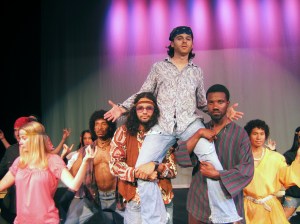
(Source: Photo, Carol Kassie, Lake Worth Playhouse)
UPDATE, Aug. 9, 2008
WOW! AWESOME!
The second time in the audience – Aug. 9, 2008, was a charm! The 2 pm matinee performance was the best! Compared to the Thursday, Aug. 31, 2008, performance, it rates a 15 out of 10 for improvement. A 5-star (out of 5) rating.
Act I was exciting! The delivery of lines was snappy and the music was in tune. What a great show! Hope the sold-out Sat. evening crowd received the best show ever. Looking forward to more performances at the playhouse!
ORIGINAL REVIEW OF SHOW, Aug. 31, 2008:
The musical, Hair, is all about politics. The audience is immersed in politics – it is unavoidable. The audience of Hair understands the production due to the prevalence of 1960s politics in the show. Any discussion of Hair would naturally include discussions of politics. Should this review be on the Opinions or Reviews page? It goes in neither location – so here it is on the Home Page.
Lake Worth Playhouse HAIR
It was about 1971. Nixon was in the White House and the Republicans controlled the executive branch of our Federal government. Watergate was an event to occur in the future. A young 16-year-old and his younger brother (about 14?) and father attended a performance of Hair on Broadway while our “little” brother (probably about 11-years-old at the time) attended another Broadway musical with the mother. What did this 16-year-old understand after that performance? One phrase: “What a piece of work is (are) [hu]man[s]!”
Last night (Thursday, July 31, 2008), that 16-year-old, now at a more advanced age, viewed the younger generation portray HIS generation in the “American Tribal Love-Rock Musical,” Hair at the Lake Worth Playhouse on Lake Avenue. As the “hallucination” scene portraying death during war concluded, this aged youth of the 70s was stabbed with the words of the 16th-century English literary genius as the characters, Jeanie and Crissy sing, “what a piece of work is man.” It hit just as hard as it did in 1971, which may indicate that little has changed in the period of 30 some years. But, most importantly, the cast of the intimate Lake Worth Playhouse achieved a goal of conveying the message that should have been conveyed – at least according to one person’s perspective. An important part of theatre is conveying a message that results in laughter or tears – emotions. The cast of Hair achieved this in its performance last night.
After several days of performance hiatus, the cast seemed to have difficulty in getting the pace of the musical moving. That is understandable. Perhaps a person writing a review should visit on Friday night after a Thursday performance?
But, compared to the slow pace at the beginning (and the intonation problems, both vocally and instrumenally, at the beginning), by the second act, everything fit together like clockwork. So, when Mr. William Shakespeare’s words were supposed to produce the intended results, they did that.
Not everything was so dismal in the first act. The snappy synchronized dance numbers, from the beginning, perhaps helped the cast get moving. At least, from the audience perspective, it seemed that way. Throughout the performance, the dance numbers were executed quite well. A reviewer may not be an expert in dance, but knows what is expected from dance numbers when viewing the “forest” rather than the “trees” – the impact of the dances on the overall stage production. The dance numbers are ddressed from such a perspective.
Other portions of the production were very good. Shane Blanford (Claude) was impressive in “Manchester England,” “I Got Life,” and the theme song, “Hair.” Equally imressive was Gina Nespoli (Sheila) in singing the songs, “I Believe in Love,” “Easy to Be Hard” and “Good Morning, Starshine.” The later two songs are well known songs from the 1960s. The former is equally as good, but has been sadly ignored. Samantha Hyon (Jeanie), Emily Riedel (Crissy), and Chanel Wright (Dionne) convinced us in a satirical manner about concerns with regard to “those detroying the earth” with the song, “Air” (‘sulfur dioxide…. gasp, gasp, gasp!”). The satire with regard to race, sex, historical perspective about life, patriotism, and old-fashioned attitudes were equally convincing.
Each song in the musical is a commentary on AAmerican life and several a commentary about life of humans on planet earth, as viewed through the eyes of 1960s culture. “I Got Life” describes the beauty of human creation by describing practically every single portion of the human body as if to praise the creation of our human lives. In 1960s “flowering” of life – a mini-Renaissance – there were still some taboos remaining. Thus, one part of the human body, the cornerstone of life, was missing from the song. The message here, particularly considering other songs in the musical, is that this part of the body is nasty – and several other songs convey this message quite eloquently. This was likely all due to Hair being a mirror of the 1960s culture. Many hoped literature and musicals like Hair would help society progress beyond the narrow and nasty. Perhaps it began that way in the 1970s, but from the 1980s forward, we began shamefully taking steps backwards. The narrow thinking has returned today – in full force. To proceed further with this discussion would be delving into opinions of politics and are best addressed on an Opinions page.
Several songs in the musical became top hits on the pop charts in the 1960s. Besides the Fifth Dimension’s version of “Aquarius/Let the Sunsine In (YouTube),” two songs sung by the character, Sheila, hit the charts: Three Dog Night did “Easy to Be Hard (YouTube)” and Oliver sang “Good Morning, Starshine (YouTube).”
Three Dog Night interpreted “Easy to Be Hard” as representative of the callousness of what we call the “right wing” and the “hawkish” “war-like” people in the USA (see the 1969 Three Dog Night video on YouTube). No doubt, Hair, targets that force in our lives – the heavy-handedness of right-wing side of the political spectrum. But, last night, listening to Ms. Nespoli (Sheila) sing the song, there is a realization we may be ignoring another side. The words, “…especially people who care about strangers; who care about evil and social injustice; do you only care about he bleeding crowd? how about a needing friend; I need a friend.” Perhaps this describes ALL people, especially the “left” or “liberal” who talk the talk, but do not walk the walk?
Related to this stanza of the song, George McEvoy, columnist for The Palm Beach Post, once described the “liberals” (perhaps those in the audiences of the original Hair production) who said they supported the Civil Rights Act of 1964, but then resisted its implementation (do not “walk the walk”). Similarly, today, the children of the 1960s and 1970s sometimes pronounce acceptance of the gay lifestyle – except when it is their own child (and subsequently toss their child out on the street; see article in April 2008 issue of Details magazine; see also the website of Parents, Families, and Friends of Lesbians and Gays – PFLAG). Perhaps the words, “bleeding heart liberals” comes from this song? Last night, the mere fact the Lake Worth Playhouse staged Hair provided another opportunity for lifelong learning. (Better shut up or risk sounding like a “bleeding heart liberal!”).
Hair is a commentary about life. The cast and crew at the Lake Worth Playhouse succeeded in conveying this message.
The song, “Air,” is about the environment. Since the 1960s and the early “Earth Days” celebrations, much has been accomplished. The Hudson River and Lake Erie (other bodies of water) have been cleaned up. There has been progress in reducing acid rain and other environmental dirt in the air, land, and seas. But carbon emissions still plague humankind today. Ironically, the MIT experts are quick to blame those “bleeding heart liberals” for making a “mountain out of a mole hill” – and we read every day about one more iceberg north of Canada that is melting. Similar issue, just a different time period today. Nevertheless, Ms. Hyon (Jeanie), Riedel (Crissy), and Wright (Dionne) provide a pertinent reminder about this problem.
The one criticism of the show is about the controversial nudity scene. But the criticism is leveled against society (er… rather the ignorant loudmouths and their traditionalist agenda).
The 16-year-old who attended the1971 performance of Hair reacted to the nude scene as just another part of the story describing life. The scene encouraged the audience to let go of everything – all masks and, yes, even clothing and recognize the beauty of humans, particularly, the beauty of youth. Rather, the loudmouths are likely paranoid about losing their youth, so turn to condemnation. The loudmouths lack self-esteem and confidence to let go and take risks for fear of being responsible for their actions. From this reviewer’s perspective, an increasingly litigious society with frivolous lawsuits (unlike the 1960s, lawyers never advertised on television) has been generated by the development of such events over time.
The production on Broadway in 1971 (if memory is good!) concluded the first act in a very synchronized and forward-moving theatrical action. The lights went off for seconds. Suddenly, the cast was on the stage standing in one line with no clothes. The cast appeared nude for about one or two seconds, then the lights went out and a curtain was drawn. That was it. It made its point.
So, is it controversy that confused the meaning of this scene last night? There also seemed to be a bit of confusion among the cast. Further, only a few shed their clothing (although not completely) and stood in the background while other actions proceeded up stage (the other actions “up staged” the actions in the back). Furhtermore, this scene was not the concluding scene. The entire “event” seemed to be staged in order to appease the purists who saw the original production while also compromising for the sake of the ignorant community loudmouths who have no appreciation of the stage. While the cast did an excellent job in conveying thoughts about life, love, war, and politics in other scenes, it was a failure during one of the most important scenes. The loudmouths win one in destroying the messages of the stage. Rules are important, except when they impede our human development. And this was an example of an impediment in order to follow rules and attempt a compromise. The compromise made it fall flat.
The fault should not be levied against the playhouse or anyone involved in the production. Let us make that perfectly clear. They did the best they could, particularly when one remains objective while considering all of what happened.
The leading players were great. Shane Blanford (Claude Hooper Bukowski) and Gina Nespoli (Sheila) did a great job. There is no point in making comparisons of these actors to the original production, except to say, they compare quite well! From the remainder of the cast, several stood out: Gregory Johnson (Hud), Emily Riedel (Crissy), Samantha Hyon (Jeanie), and Chanel Wright (Dionne).
It is quite possible Gregory Johnson had a better voice than what we heard in the audience. Perhaps the position of the microphone caused some distortions?
The award for (apparent) newcomer goes to Chanel Wright. In the original productions, Melba Moore played the role of Dionne. As Chanel’s first appearance (according to her bio), she did a superb job playing the role “created” by Ms. Moore in the 1960s. Are we going to see and hear more of her?
And will we see and hear more of the entire cast of Hair? That would be great! There is a great bunch of talent there.
Overall, out of a score of 1 to 10, I give the production of Hair 8 (eight). The first act had a lower rating, but balanced out by the higher rating of the second act.
Additional performances? Friday and Saturday, Aug. 1 & 2, 2008, 8 pm. Matinee performance, Saturday, Aug. 2, 2008, 2 pm.
For information about future productions of Hair, go to http://www.lakeworthplayhouse.org/Hair.html . (more…)
 Tioga Herald
New York Times Book Review (March 14, 2021 by Ted Genoways): Mark Bittman Book: Animal, Vegetable, Junk
After reading a review written by Ted Genoways, Professor Cornwell is interest in locating and reading this book, Animal, Vegetable, Jun: From Sustainable to Suicidal. It contains a “sweeping history of our sources of food, tracking the shift from agriculture to agribusiness.” It will be interesting to understand the path for the future, as Bittman sees it, as we move forward with the nominee for the head of the U.S. Department of Agriculture nominee, Tom Vilsack.
What caught Cornwell’s attention was the discussion about how agribusiness has hurt farming and agriculture in smaller rural areas. The reference was to “ranches,” which can be compared to large or factory farms. It is understood that such farms in “rural areas” have been hurt. Professor Cornwell then asks, what about non-factory farms in rural areas such as Upstate New York? Cornwell has always spoken up about the destruction of small business, the backbone of America as it developed, with big corporate “boxes” created by “free market” methods with which Cornwell has no stomach. It has been written that “free markets” are good for some who pick themselves up from nothing and become huge corporations in the process, only to then destroy the “free markets.” This idea can be considered analogous to another an issue discussed in another book review in this edition of the New York Times (“Pilgrim Law,” by Frances J. Bremer in a review of Tobey Pearl’s book, Terror to the Wicked: America’s First Trial by Jury That Ended a War and Helped to Form a Nation). This would be idea that religious organizations which have seen discrimination against their own people but then they become the “discriminators.” Same thing with “free market” advocates like Libertarians and anarchists as big corporations are developed into monopoly-style businesses and then work, like Roman gladiators, to destroy the competition. Religious groups work to destroy the competition, the same as Roman gladiators did to Christians and others in the arenas of Ancient Rome. Dictatorship.
To justify this sense of being “unchecked corporatization” and “laissez-faire economics,” The discussion centers on the “delineation” between this activity in America to what Joseph Stalin did to agriculture in the former Soviet Union. Professor Cornwell has been discussing facts that there IS no delineation between centralized economics of big corporate monopolized industries of ANY kind, to what the big communes of the former Soviet Union. Both are based on supply side economics with no concern for the demand side, which is truly a major part of capitalism and capitalist competition which can be controlled by regulatory practices from a third party: the government. Otherwise, we end up with the supply side of the economic picture regulating itself, similar to a government which controls the supply side by removing corporate businesses completely. Both are dictatorial and in the case of the USA, there is too much influence by the big corporate giants and the 1% of those who own the resources, of our government by way of PACs and lobbyists. Does this type of lobbyist and PAC influence exist in Senator Bernie Sanders’s home state of Vermont? Do not big corporations exist in Vermont only in more densely populated areas of the state, thus helping to make the small businesses more like King David, the underdog, when fighting the big Goliath of the industries?
New York state and other states, too, lose out (perhaps Vermont, too?), due to the hills. Such states were once the largest producers of agricultural goods in the USA. Between Prohibition and the development of factory farms, New York is one state which has been hurt. After all, with soil in hilly areas, big factory farm equipment is unusable. Cornwell’s late father mentioned this when asked why there are no factory farms in New York. Was he correct?
In the hills of Pennsylvania, the observation which could be made is that its industry was the coal industry. Now, without the coal industry, what about factory farms on the hills of Pennsylvania? One could say that Upstate New York and Pennsylvania, with the hills, are hurt by the factory farms.
What was not mentioned in this review of a book was the impact of the fast food industry on the increased obesity and rates of type II diabetes in America. Certainly, America as the breadbasket of the world is one of honor for America. However, in documentaries discussing the low cost of fast foods, those who are low income have turned to the fast foods. In America, which parts of the population generally fall more into the “lower classes?” According to documentaries about the increase of diabetes, which groups of Americans have seen an increase in diabetes to a great extent?
Into the picture comes big pharma. We are delighted at the great role America takes with big pharma, yet we ignore the fact that lower class people are usually those who suffer from larger unemployment or work at jobs which do not provide healthcare insurance (as was done to America by lousy, lousy, lousy former Governor Rick Scott of Florida, now a lousy, lousy, lousy U.S. Senator and the goons who are attempting to destroy Obamacare, designed to help stimulate CAPITALIST COMPETITION, not SOCIALISM, as the liars who wish to destroy it make a lousy false claim. Professor Cornwell is angered by this attitude and its strong influence with money, over people of America.
Yes, there is a wonderful thing for lower cost fast foods. But how much fast food can one eat and then purchase trade name meds at ripoff prices. Fast food and this food industry today, with many of its retailers, do little or nothing to provide foods which are better for diabetics. Yes. “We have the bananas,” but the foods which are highlighted are GF or gluten free. All for those types of diets. Fact. Cornwell’s mother and maternal grandmother rarely ate fast foods. The diabetes developed later in life. Go ahead, twist it all around because of not being comfortable if there might be some truth to this and the truth hurts.
Thanks so much for big fat corporate conglomerate agribusiness and the fast food industry. The fast food industry like McDonald’s, was run by vicious people like Ray Kroc who worked diligently to locate new restaurants in places where there were nearby “mom and pop” restaurants. They grabbed at the “instant gratification” movement. Being blamed for this “reality” today is the development of fast food businesses, due to females of the 1960s who wanted to get out of the kitchen and go work in jobs. Oh, really? What a sad thing to consider. Perhaps it was the big corporate misogynists who just found a way to take advantage of this situation and then work for “anything goes” ideas resulting in sexual harassment?
The bumper sticker was, “Women belong in the House [of Representatives], not the kitchen.” With many female Democrats going to the “House,” Trump and his misogynist friends don’t like that. In fact, he gropes women and gets away with it, along with all the other crap for which he gets acquitted.
Today, McDonald’s wishes to replace employees with robots. Wonderful. And how is this move going to justify what happens to the supply siders in their thrust for dictatorship in America. Then we have people out of work and turning to drugs, then beef up law and order because “idle hands is the devil’s playground.”
Reading the book might help clear up anything, should there be a misunderstanding here. Do we await the availability in Upstate New York libraries or purchase one? Is there a library which rents all the newest books and checks them out to patrons? Hmmmm… That would be nice.
Folks can be thankful for the reviews in the New York Times. Folks can stay abreast of the latest books and that works, too.
Category:
Book Reviews, New Comments
Tagged with: