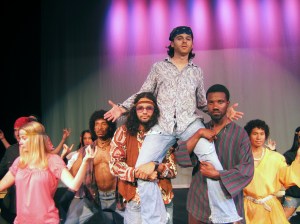
(Source: Photo, Carol Kassie, Lake Worth Playhouse)
UPDATE, Aug. 9, 2008
WOW! AWESOME!
The second time in the audience – Aug. 9, 2008, was a charm! The 2 pm matinee performance was the best! Compared to the Thursday, Aug. 31, 2008, performance, it rates a 15 out of 10 for improvement. A 5-star (out of 5) rating.
Act I was exciting! The delivery of lines was snappy and the music was in tune. What a great show! Hope the sold-out Sat. evening crowd received the best show ever. Looking forward to more performances at the playhouse!
ORIGINAL REVIEW OF SHOW, Aug. 31, 2008:
The musical, Hair, is all about politics. The audience is immersed in politics – it is unavoidable. The audience of Hair understands the production due to the prevalence of 1960s politics in the show. Any discussion of Hair would naturally include discussions of politics. Should this review be on the Opinions or Reviews page? It goes in neither location – so here it is on the Home Page.
Lake Worth Playhouse HAIR
It was about 1971. Nixon was in the White House and the Republicans controlled the executive branch of our Federal government. Watergate was an event to occur in the future. A young 16-year-old and his younger brother (about 14?) and father attended a performance of Hair on Broadway while our “little” brother (probably about 11-years-old at the time) attended another Broadway musical with the mother. What did this 16-year-old understand after that performance? One phrase: “What a piece of work is (are) [hu]man[s]!”
Last night (Thursday, July 31, 2008), that 16-year-old, now at a more advanced age, viewed the younger generation portray HIS generation in the “American Tribal Love-Rock Musical,” Hair at the Lake Worth Playhouse on Lake Avenue. As the “hallucination” scene portraying death during war concluded, this aged youth of the 70s was stabbed with the words of the 16th-century English literary genius as the characters, Jeanie and Crissy sing, “what a piece of work is man.” It hit just as hard as it did in 1971, which may indicate that little has changed in the period of 30 some years. But, most importantly, the cast of the intimate Lake Worth Playhouse achieved a goal of conveying the message that should have been conveyed – at least according to one person’s perspective. An important part of theatre is conveying a message that results in laughter or tears – emotions. The cast of Hair achieved this in its performance last night.
After several days of performance hiatus, the cast seemed to have difficulty in getting the pace of the musical moving. That is understandable. Perhaps a person writing a review should visit on Friday night after a Thursday performance?
But, compared to the slow pace at the beginning (and the intonation problems, both vocally and instrumenally, at the beginning), by the second act, everything fit together like clockwork. So, when Mr. William Shakespeare’s words were supposed to produce the intended results, they did that.
Not everything was so dismal in the first act. The snappy synchronized dance numbers, from the beginning, perhaps helped the cast get moving. At least, from the audience perspective, it seemed that way. Throughout the performance, the dance numbers were executed quite well. A reviewer may not be an expert in dance, but knows what is expected from dance numbers when viewing the “forest” rather than the “trees” – the impact of the dances on the overall stage production. The dance numbers are ddressed from such a perspective.
Other portions of the production were very good. Shane Blanford (Claude) was impressive in “Manchester England,” “I Got Life,” and the theme song, “Hair.” Equally imressive was Gina Nespoli (Sheila) in singing the songs, “I Believe in Love,” “Easy to Be Hard” and “Good Morning, Starshine.” The later two songs are well known songs from the 1960s. The former is equally as good, but has been sadly ignored. Samantha Hyon (Jeanie), Emily Riedel (Crissy), and Chanel Wright (Dionne) convinced us in a satirical manner about concerns with regard to “those detroying the earth” with the song, “Air” (‘sulfur dioxide…. gasp, gasp, gasp!”). The satire with regard to race, sex, historical perspective about life, patriotism, and old-fashioned attitudes were equally convincing.
Each song in the musical is a commentary on AAmerican life and several a commentary about life of humans on planet earth, as viewed through the eyes of 1960s culture. “I Got Life” describes the beauty of human creation by describing practically every single portion of the human body as if to praise the creation of our human lives. In 1960s “flowering” of life – a mini-Renaissance – there were still some taboos remaining. Thus, one part of the human body, the cornerstone of life, was missing from the song. The message here, particularly considering other songs in the musical, is that this part of the body is nasty – and several other songs convey this message quite eloquently. This was likely all due to Hair being a mirror of the 1960s culture. Many hoped literature and musicals like Hair would help society progress beyond the narrow and nasty. Perhaps it began that way in the 1970s, but from the 1980s forward, we began shamefully taking steps backwards. The narrow thinking has returned today – in full force. To proceed further with this discussion would be delving into opinions of politics and are best addressed on an Opinions page.
Several songs in the musical became top hits on the pop charts in the 1960s. Besides the Fifth Dimension’s version of “Aquarius/Let the Sunsine In (YouTube),” two songs sung by the character, Sheila, hit the charts: Three Dog Night did “Easy to Be Hard (YouTube)” and Oliver sang “Good Morning, Starshine (YouTube).”
Three Dog Night interpreted “Easy to Be Hard” as representative of the callousness of what we call the “right wing” and the “hawkish” “war-like” people in the USA (see the 1969 Three Dog Night video on YouTube). No doubt, Hair, targets that force in our lives – the heavy-handedness of right-wing side of the political spectrum. But, last night, listening to Ms. Nespoli (Sheila) sing the song, there is a realization we may be ignoring another side. The words, “…especially people who care about strangers; who care about evil and social injustice; do you only care about he bleeding crowd? how about a needing friend; I need a friend.” Perhaps this describes ALL people, especially the “left” or “liberal” who talk the talk, but do not walk the walk?
Related to this stanza of the song, George McEvoy, columnist for The Palm Beach Post, once described the “liberals” (perhaps those in the audiences of the original Hair production) who said they supported the Civil Rights Act of 1964, but then resisted its implementation (do not “walk the walk”). Similarly, today, the children of the 1960s and 1970s sometimes pronounce acceptance of the gay lifestyle – except when it is their own child (and subsequently toss their child out on the street; see article in April 2008 issue of Details magazine; see also the website of Parents, Families, and Friends of Lesbians and Gays – PFLAG). Perhaps the words, “bleeding heart liberals” comes from this song? Last night, the mere fact the Lake Worth Playhouse staged Hair provided another opportunity for lifelong learning. (Better shut up or risk sounding like a “bleeding heart liberal!”).
Hair is a commentary about life. The cast and crew at the Lake Worth Playhouse succeeded in conveying this message.
The song, “Air,” is about the environment. Since the 1960s and the early “Earth Days” celebrations, much has been accomplished. The Hudson River and Lake Erie (other bodies of water) have been cleaned up. There has been progress in reducing acid rain and other environmental dirt in the air, land, and seas. But carbon emissions still plague humankind today. Ironically, the MIT experts are quick to blame those “bleeding heart liberals” for making a “mountain out of a mole hill” – and we read every day about one more iceberg north of Canada that is melting. Similar issue, just a different time period today. Nevertheless, Ms. Hyon (Jeanie), Riedel (Crissy), and Wright (Dionne) provide a pertinent reminder about this problem.
The one criticism of the show is about the controversial nudity scene. But the criticism is leveled against society (er… rather the ignorant loudmouths and their traditionalist agenda).
The 16-year-old who attended the1971 performance of Hair reacted to the nude scene as just another part of the story describing life. The scene encouraged the audience to let go of everything – all masks and, yes, even clothing and recognize the beauty of humans, particularly, the beauty of youth. Rather, the loudmouths are likely paranoid about losing their youth, so turn to condemnation. The loudmouths lack self-esteem and confidence to let go and take risks for fear of being responsible for their actions. From this reviewer’s perspective, an increasingly litigious society with frivolous lawsuits (unlike the 1960s, lawyers never advertised on television) has been generated by the development of such events over time.
The production on Broadway in 1971 (if memory is good!) concluded the first act in a very synchronized and forward-moving theatrical action. The lights went off for seconds. Suddenly, the cast was on the stage standing in one line with no clothes. The cast appeared nude for about one or two seconds, then the lights went out and a curtain was drawn. That was it. It made its point.
So, is it controversy that confused the meaning of this scene last night? There also seemed to be a bit of confusion among the cast. Further, only a few shed their clothing (although not completely) and stood in the background while other actions proceeded up stage (the other actions “up staged” the actions in the back). Furhtermore, this scene was not the concluding scene. The entire “event” seemed to be staged in order to appease the purists who saw the original production while also compromising for the sake of the ignorant community loudmouths who have no appreciation of the stage. While the cast did an excellent job in conveying thoughts about life, love, war, and politics in other scenes, it was a failure during one of the most important scenes. The loudmouths win one in destroying the messages of the stage. Rules are important, except when they impede our human development. And this was an example of an impediment in order to follow rules and attempt a compromise. The compromise made it fall flat.
The fault should not be levied against the playhouse or anyone involved in the production. Let us make that perfectly clear. They did the best they could, particularly when one remains objective while considering all of what happened.
The leading players were great. Shane Blanford (Claude Hooper Bukowski) and Gina Nespoli (Sheila) did a great job. There is no point in making comparisons of these actors to the original production, except to say, they compare quite well! From the remainder of the cast, several stood out: Gregory Johnson (Hud), Emily Riedel (Crissy), Samantha Hyon (Jeanie), and Chanel Wright (Dionne).
It is quite possible Gregory Johnson had a better voice than what we heard in the audience. Perhaps the position of the microphone caused some distortions?
The award for (apparent) newcomer goes to Chanel Wright. In the original productions, Melba Moore played the role of Dionne. As Chanel’s first appearance (according to her bio), she did a superb job playing the role “created” by Ms. Moore in the 1960s. Are we going to see and hear more of her?
And will we see and hear more of the entire cast of Hair? That would be great! There is a great bunch of talent there.
Overall, out of a score of 1 to 10, I give the production of Hair 8 (eight). The first act had a lower rating, but balanced out by the higher rating of the second act.
Additional performances? Friday and Saturday, Aug. 1 & 2, 2008, 8 pm. Matinee performance, Saturday, Aug. 2, 2008, 2 pm.
For information about future productions of Hair, go to http://www.lakeworthplayhouse.org/Hair.html . (more…)

 Tioga Herald
I am Who I am and Proud to be Who I am
I am gay and knew it from a young age, but was bullied by many to reject who I am because I did not play sports as a “man” could. Yet, I was part of a championship football team (JV) in high school.
My JV football coach was also my 7th grade New York State History teacher. I learned from him regarding history. I learned from him regarding football.
I am a Christian, raised in a Protestant denomination. With today being Ash Wednesday, I am reminded of the football coach who boarded in our home. When I was a kid, he came home after attending the local Roman Catholic Church. He had ashes on his forehead in the sign of the cross. I had never seen that before. I went over and asked him what that was about. My mother was embarrassed that I would ask or, as she said, “bother” him about that. But he was not the least bit bothered and explained to me what the ashes were about. Our Protestant church in Newark Valley never had an Ash Wednesday service like that. But the UCC I attended in Florida DID have an Ash Wednesday service and I received my ashes, while participating in the choir in that church. The service followed a dinner of homemade soups made by members of the congregation.
I am who I am.
The basketball coach who boarded at the the same time as the football coach introduced me to the book Fahrenheit 451 by Ray Bradbury. Did you know that paper burns at 451 degrees Fahrenheit? The story was about a time in the future when firemen were not used to protect us from burning homes, but to burn books which were not pleasing to some people. The basketball coach gave me a copy of that book.
The basketball coach also gave me a copy about a white man who lived among a black community so as to discover how black folk were treated in the South. The book was titled, Black Like Me.
These coaches were borders at our house in Apr. 1968 when Rev. Dr. Martin Luther King, Jr. , was shot down in cold blood. Sad that I was exposed to so many people in our school and community who rejoiced at the murder of MLK. I did not know how to accept it all. So, I asked the basketball coach whether it was right for people to rejoice at the death of a black man. He answered my question with a question. His question for me, to get me thinking, was this: ”What do you think?” I thought and thought and replied with, “I don’t think it is very good for anyone to kill another nor to even rejoice over it.” To which the basketball coach said, “I think you answered your own question correctly.”
From that point forward, to the day I heard the song “Who Am I?” in Les Miz, to today, I am always willing to take responsibility for mistakes I might make.
This is a long-winded approach to say this. Several days back, I wrote a review of a local production of Cabaret, which I had really enjoyed and appreciated. I take responsibility for the errors in that review. Not errors in what I said or the references provided. Errors in my writing. Run-on sentences, for instance. I had written the review so quickly and had to deal with so many problems with the app with which I was using, that I just submitted it without a thorough review of it. Sad.
I take responsibility, despite the fact that I COULD blame the technology. I LOVE to blame the technology. And today’s technology leaves a lot to be desired, from inept and non-intuitive phone apps and so forth, to stupid AI which makes changes I don’t want, to many other ineptitudes of technology.
And some would think, to be a “man,” I need to hide my mistakes and lie. That is very unacceptable to me.
So, I am who I am. Trying to be an honest man who seeks quality in life, even though the fat pigs of big corporate supply-side companies deny us quality control and don’t know what it means to analyze quality control. So that so many common folk have no idea what quality control is and then finds some way to blame me and others when we seek it.
Perhaps I will have a chance to re-do that review of Cabaret and correct errors such as run-on sentences. At least I did NOT use foul language in it. And words of my analysis will be the same. I just need to tweak it a bit. And perhaps this time around, I will learn something and do something different. I might use Microsoft Word to write it and then copy and paste it into the app! Humility begets learning and learning begets knowledge which begets wisdom. Seek wisdom, not certainty and life resulting humility would be better for all in America.
My tastes are simple being satisfied with the best. (Attributed to Oscar Wilde).
Category:
Commentary, Theatre reviews
Tagged with: